


From wind turbines and radio base stations to substations, rail networks and lightning protection systems, reliable Earthing is essential for both operational performance and human safety. However, concerns around defective earthing designs, Earth Potential Rise (EPR) and dangerous touch voltages are becoming increasingly common across modern infrastructure projects, as highlighted by Simon Gallagher, MD at UK Networks Services. This makes robust, engineered grounding solutions more important than ever. Luckily for you, the Elpress Deep Earthing System provides a modern, controlled and highly reliable approach to electrical grounding. Continue reading this blog to learn more about the system, soil resistivity, common applications and the key benefits of deep earthing technology.
What is an Electrical Earthing System?
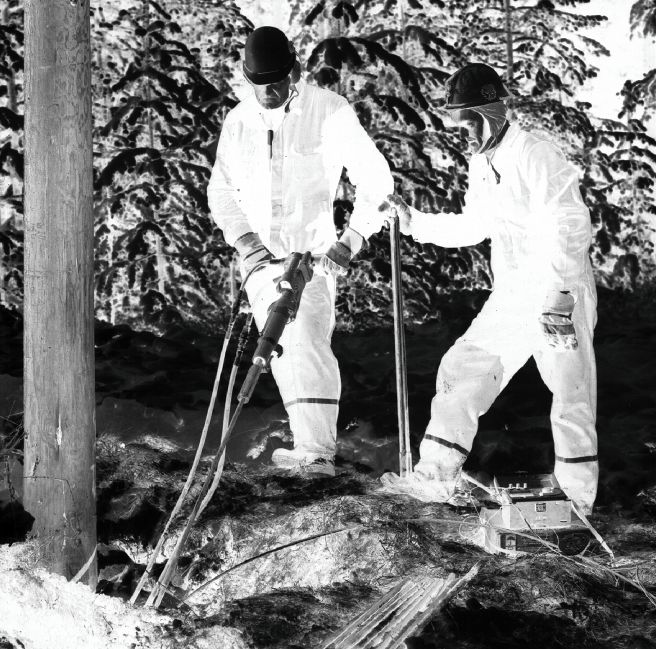

Earthing is used for a wide range of applications including personal protection, equipment and property protection, lightning protection systems, and surge and electromagnetic protection. In high-risk environments such as substations, wind farms and telecommunications networks, poor earthing design can lead to equipment failure, unstable system performance and dangerous touch voltages.
| What is Electrical Earthing? – Read Our Full Blog |
Soil Resistivity and Why It Matters

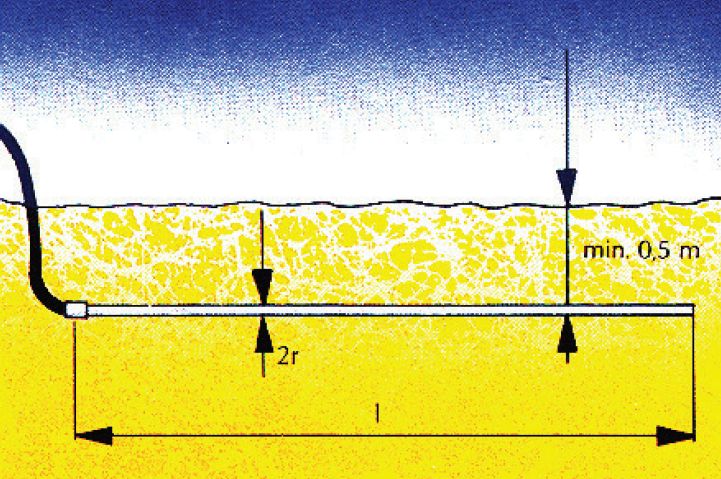
Surface Earthing vs Deep Earthing

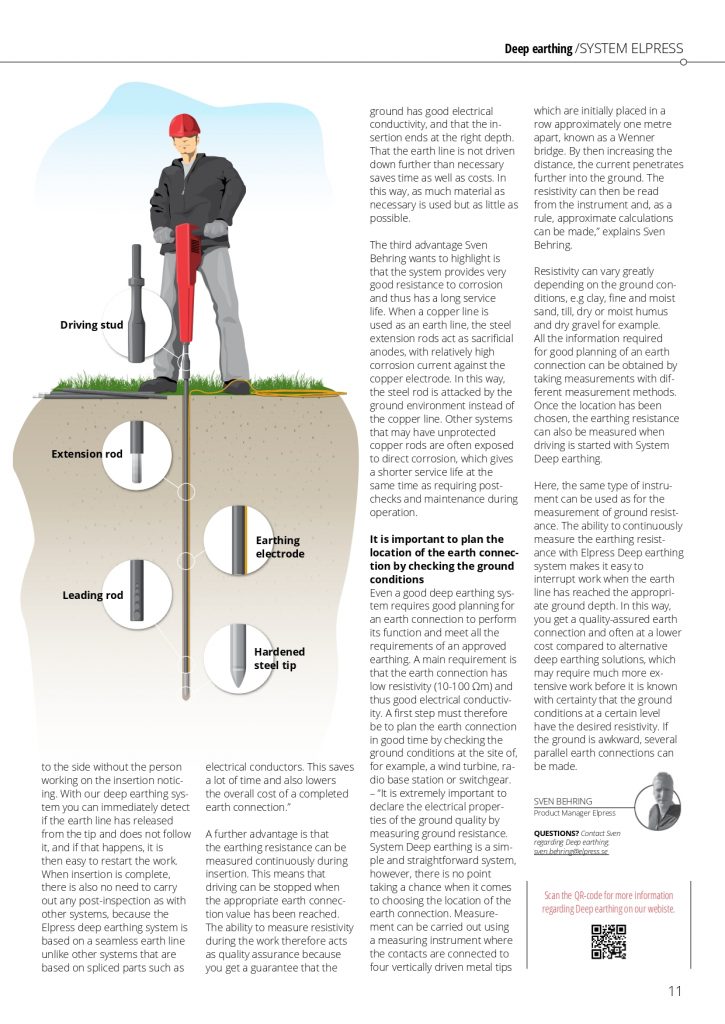
The Elpress Deep Earthing System Explained

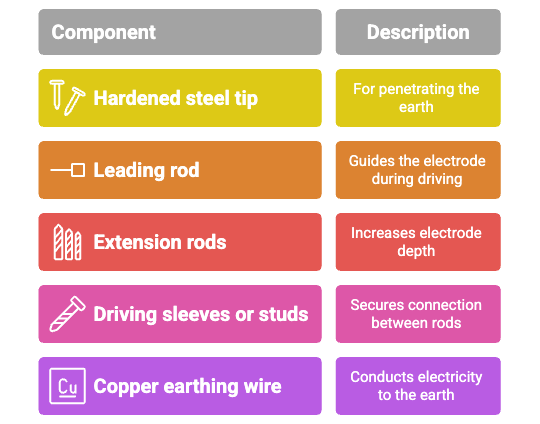
How the Elpress Deep Earthing System Works in Practice

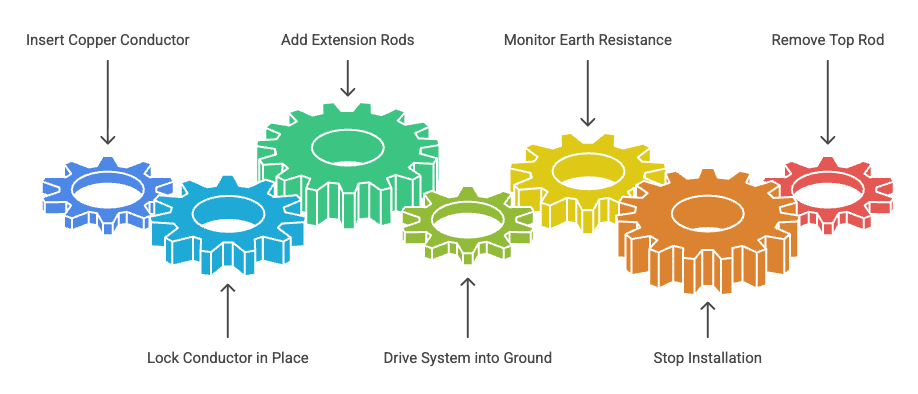
Monitoring, Safety and Engineering Benefits
One of the key advantages of the system is continuous earth resistance monitoring during installation. This allows installers to achieve the correct grounding depth, prevent unnecessary over-extension, and validate ground conditions in real time.
Corrosion protection is also an integral part of the system, as the steel rods act as sacrificial anodes when copper conductors are used, protecting the copper and extending overall system lifespan. In addition, the system is aligned with key industry standards such as IEC 62305-3 for lightning protection systems and SS-EN 50164-2 for earthing component requirements, ensuring safe and reliable performance in demanding electrical environments.
| Elpress Deep Earthing System Benefits – Read Our Full Blog |
Applications and Product Range
Engineers use the Elpress Deep Earthing System across critical infrastructure sectors including wind turbine grounding systems, radio base stations, electrical substations, rail infrastructure, switchgear / transformer installations, and lightning protection systems.
The system is built around a modular FS range of components, including FS11 and FS12 steel tips, FS21 leading rods, FS31 extension rods, FSHD heavy-duty variants designed for hard ground conditions, FS61 impact studs, FS62 impact sleeves, and the FS41 withdrawal handle.
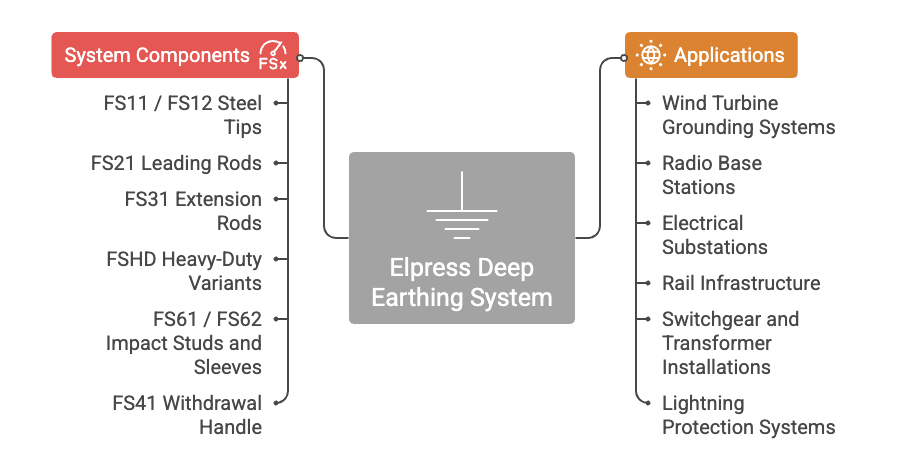

The Product Range Itself
| Image | Cat. No | Description | Area | Ø | Pcs / Pack | Weight | Length | Width | Used For | To Be Used With |
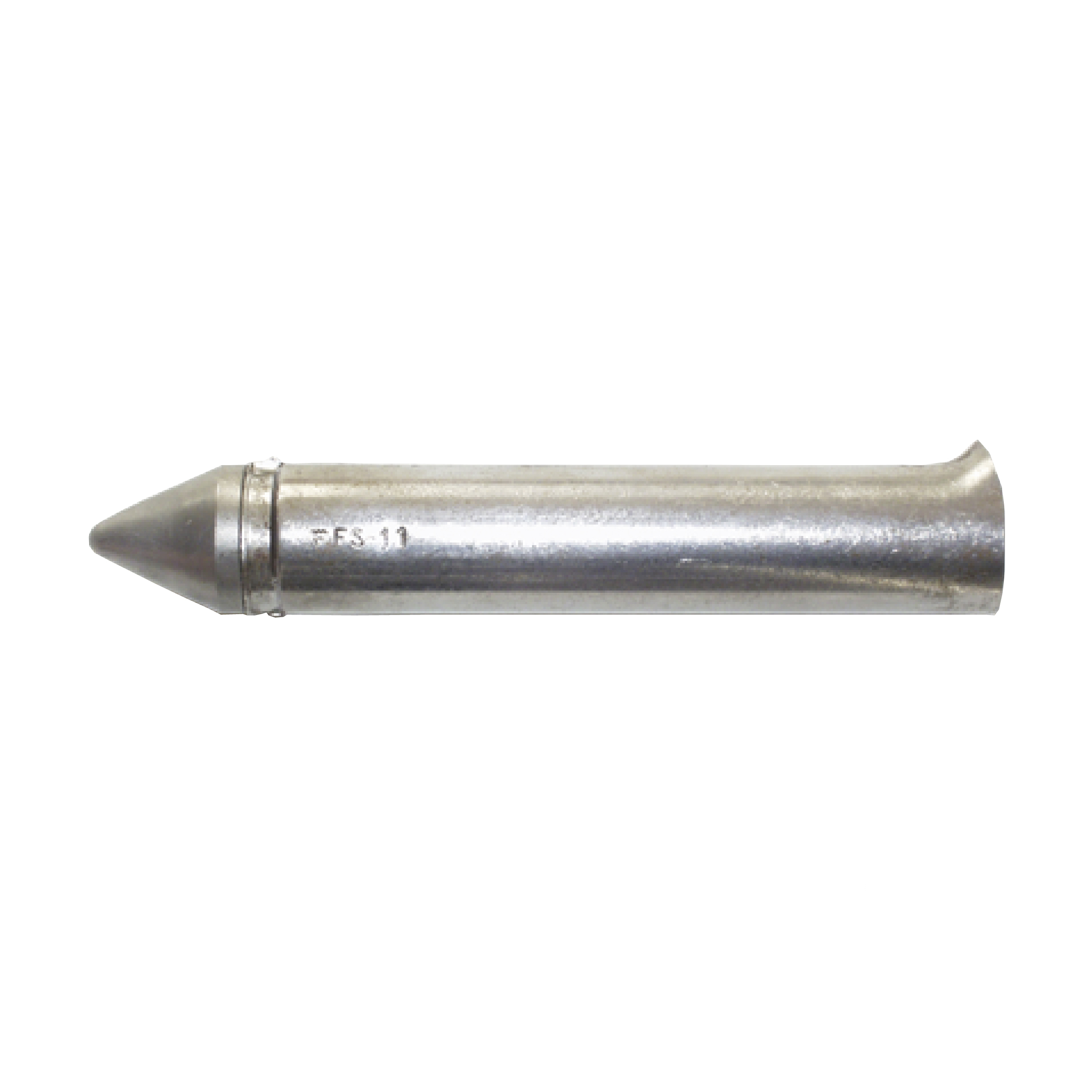 |
FS11 | Hardened steel tip for FS21, compatible with various earth lines. | 16-70 mm2 | – | 5 | 0,176 kg | 135 mm | – | – | FS21 Rod |
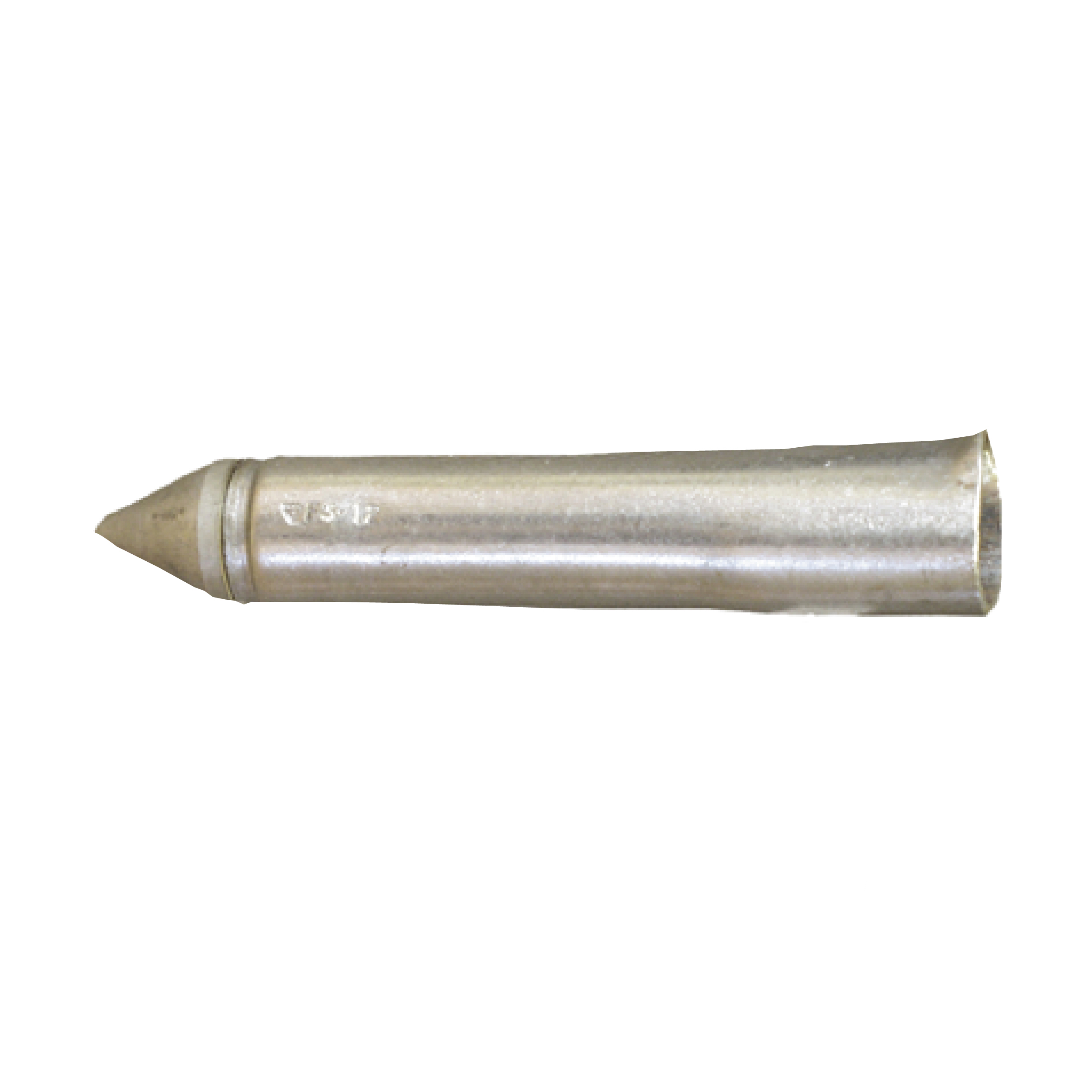 |
FS12 | Hardened steel tip for FS21, compatible with various earth lines. | 70-150 mm2 | – | 5 | 0,176 kg | 135 mm | – | – | FS21 Rod |
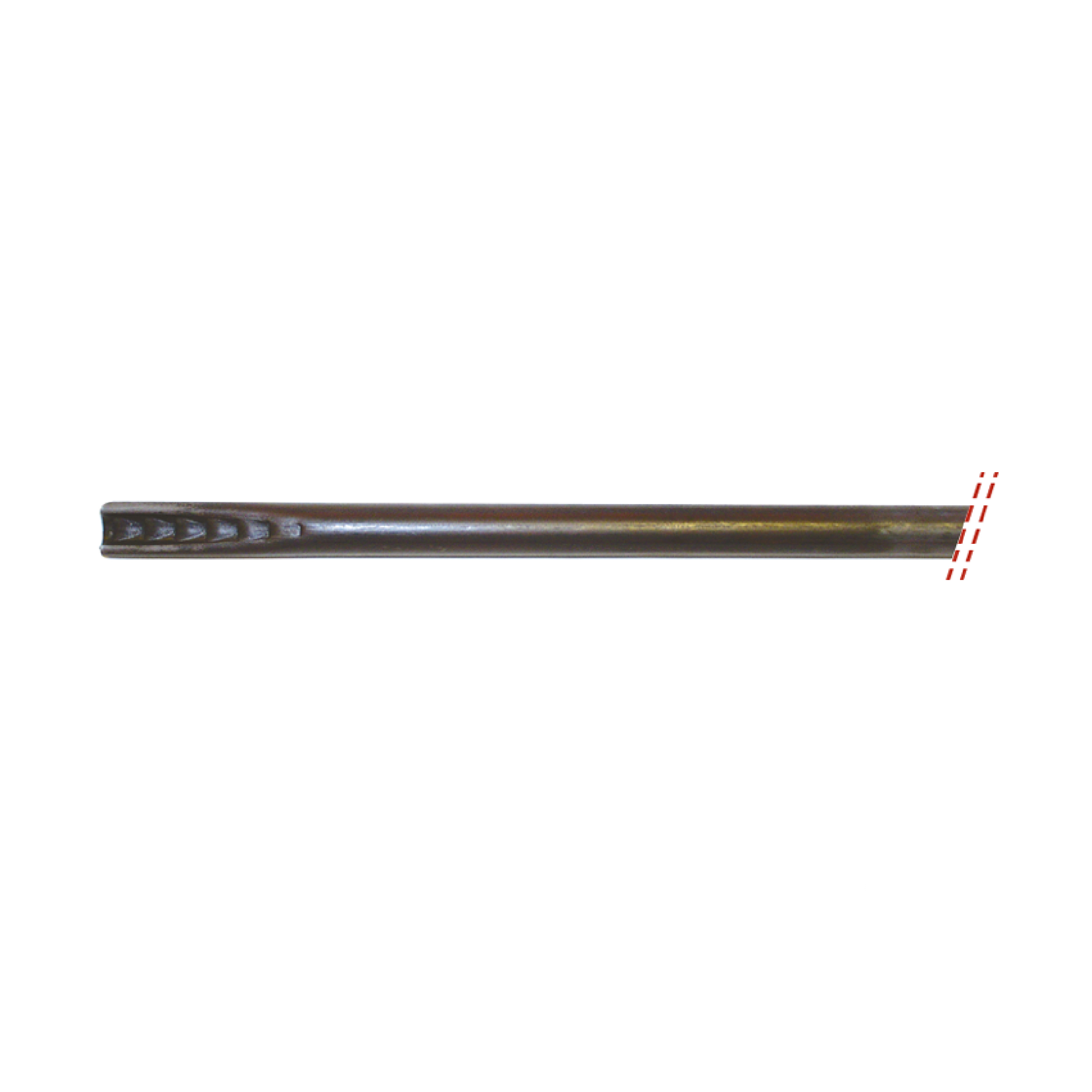 |
FS21 | Steel leading rod with grooved notch for secure earth line locking. For loose and normal soils. | – | 17 mm | 5 | 0,644 kg | 800 mm | – | Loose and normal soil | – |
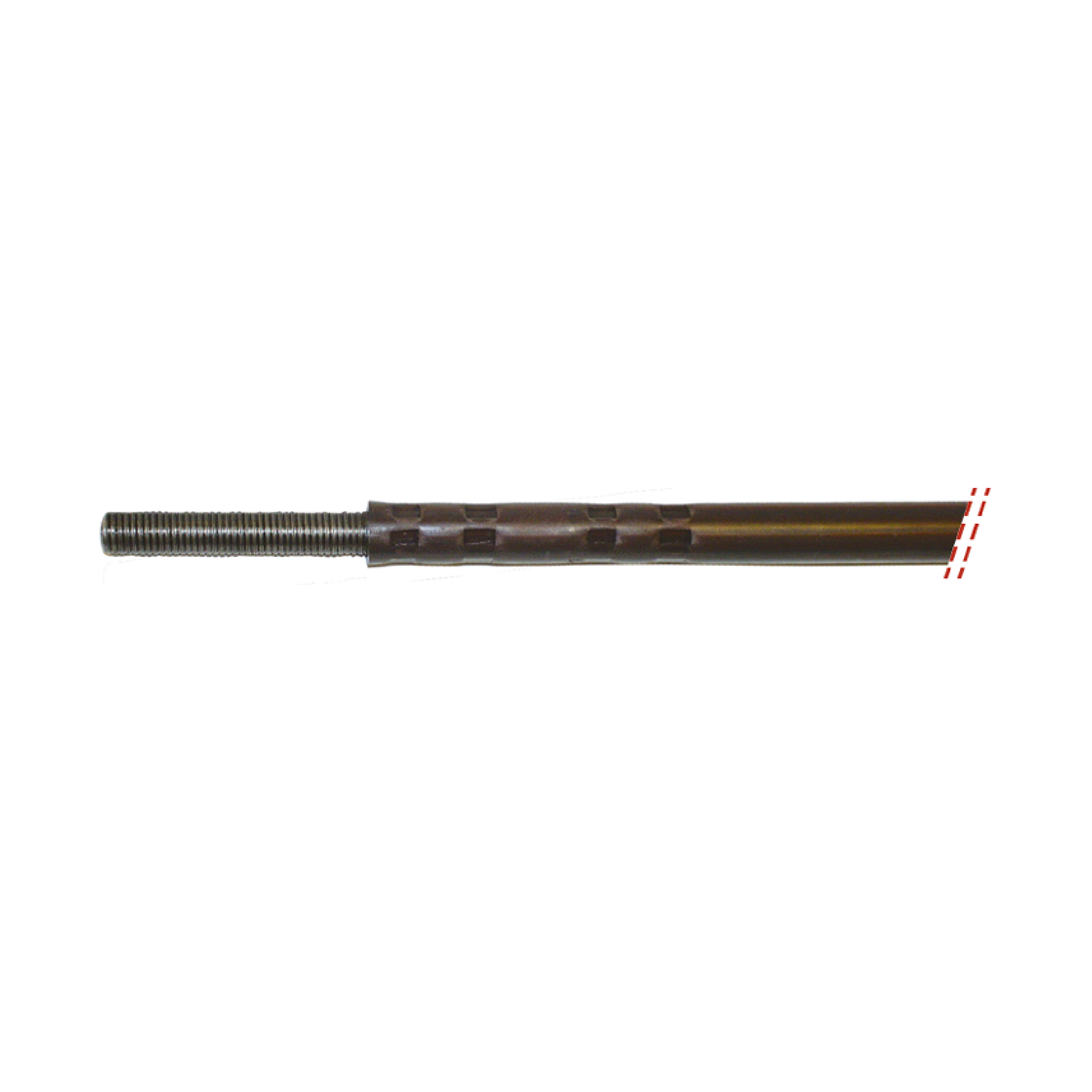 |
FS31 | HD steel extension rod with guide pin for preceding rod. For loose and normal soils. | – | 17 mm | 5 | 0,804 kg | 870 mm (including driving cap) | – | Loose and normal soil | – |
 |
FS62C – Impact Sleeve FS | Impact sleeve for sledgehammer driving, preventing rod-end deformation. | – | – | 1 | 1,018 kg | 110 mm | – | – | FS21 or FS31 Rods |
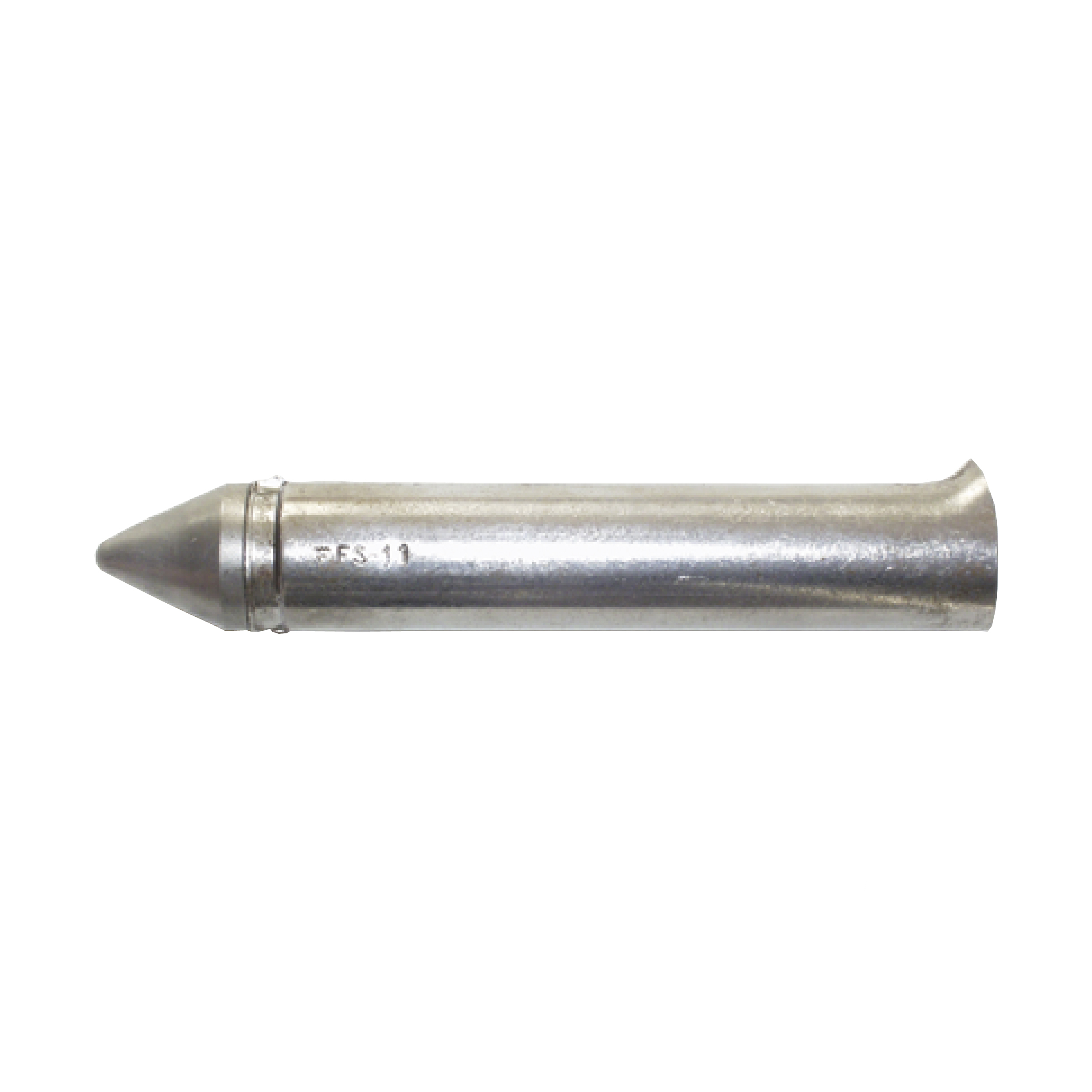 |
FSHD11 | Hardened steel tip for hard and rocky ground conditions. | 25-150 mm2 | – | 5 | 0,254 kg | 153 mm | – | Hard and rocky ground | FSHD23 Rod |
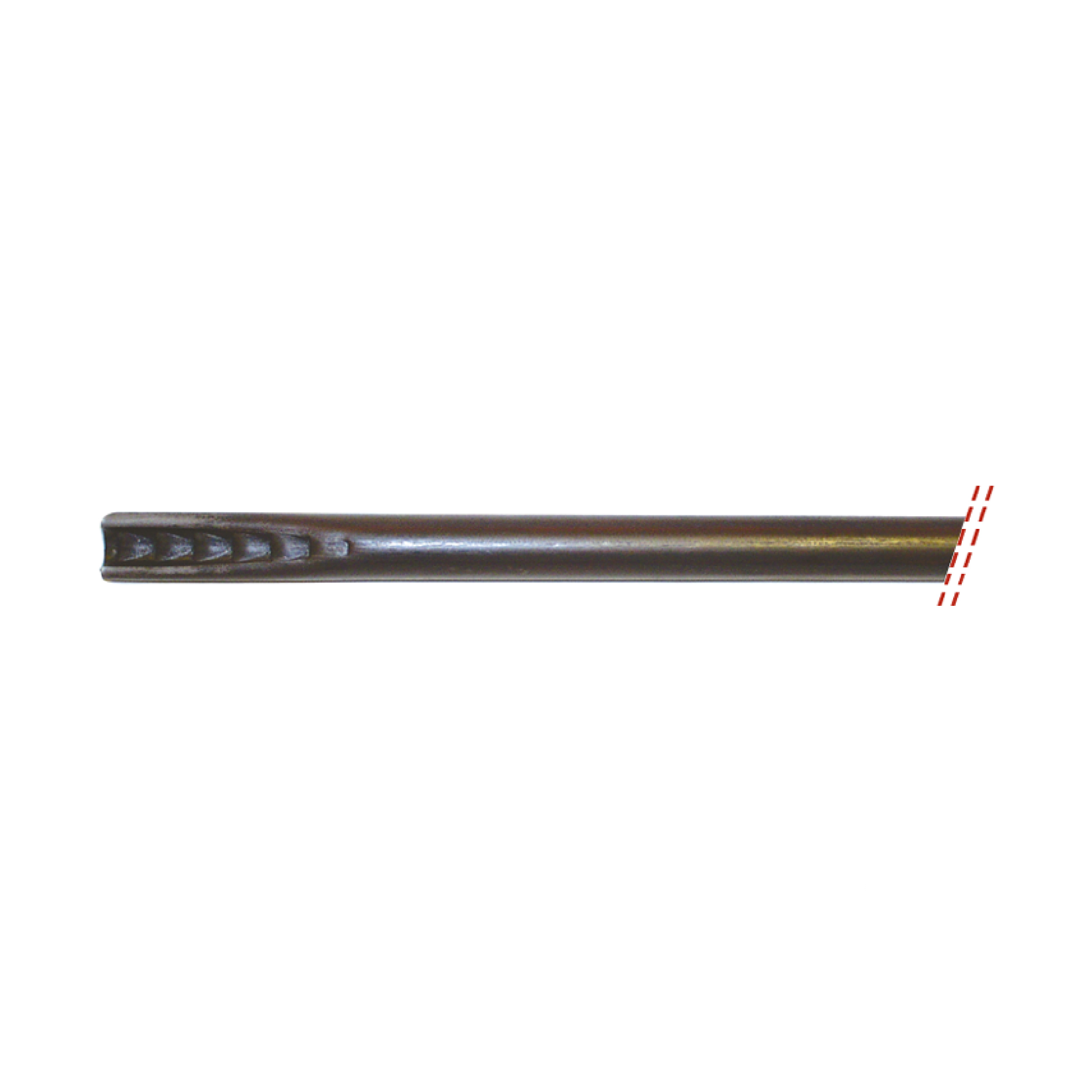 |
FSHD23 | Steel leading rod with grooved notch for secure earth line locking. | – | 21 mm | 5 | 1,088 kg | 800 mm | – | Hard and rocky ground | FSHD11 Tip |
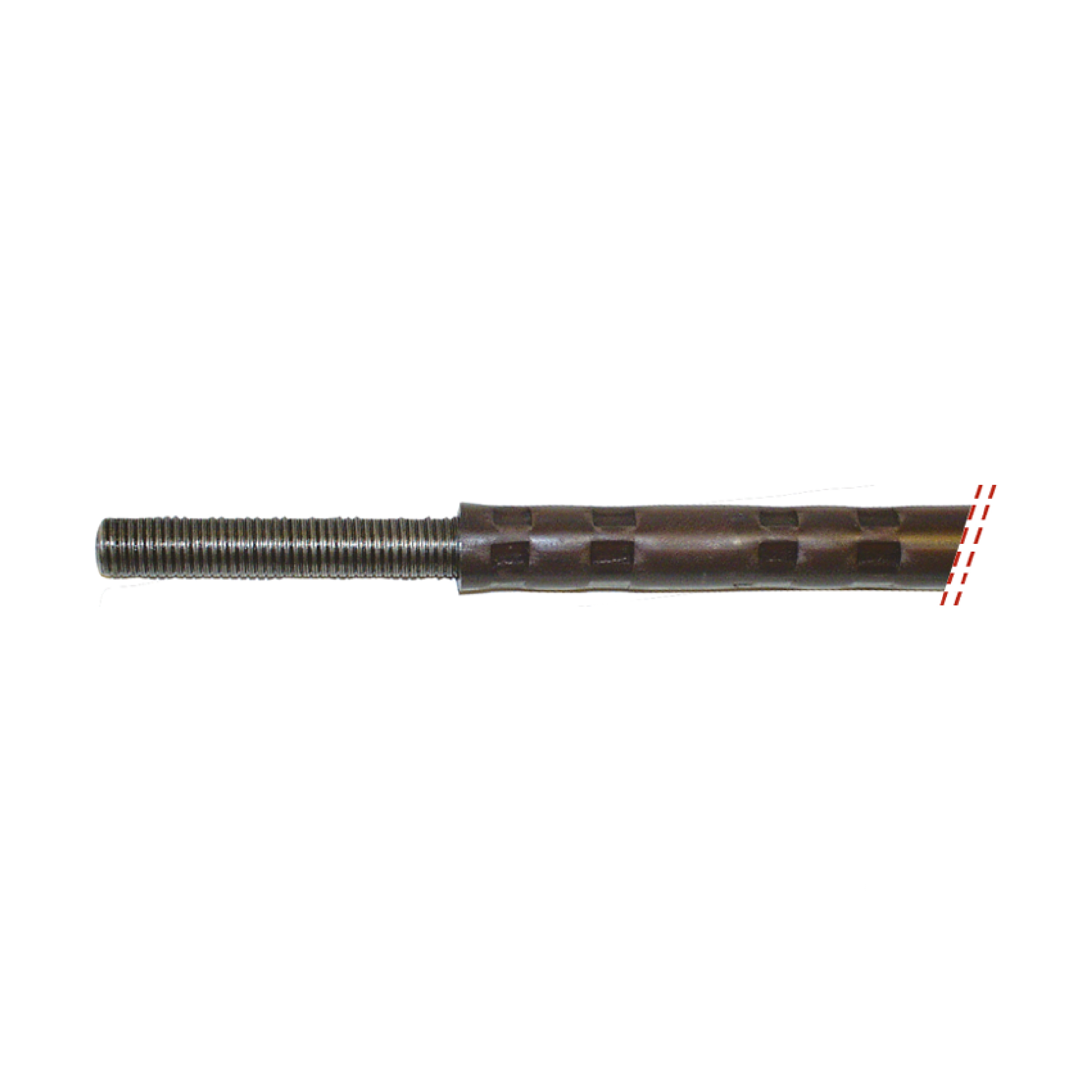 |
FSHD31 | HD steel extension rod with guide pin for preceding rod. | – | 21 mm | 5 | 1,224 kg | 870 mm (including driving cap) | – | Hard and rocky ground | – |
 |
FSHD62C – Impact Sleeve FSHD | Impact sleeve for sledgehammer driving, preventing rod-end deformation. | – | – | 1 | 0,93 kg | 110 mm | 45 mm | – | FSHD23 or FSHD31 Rods |
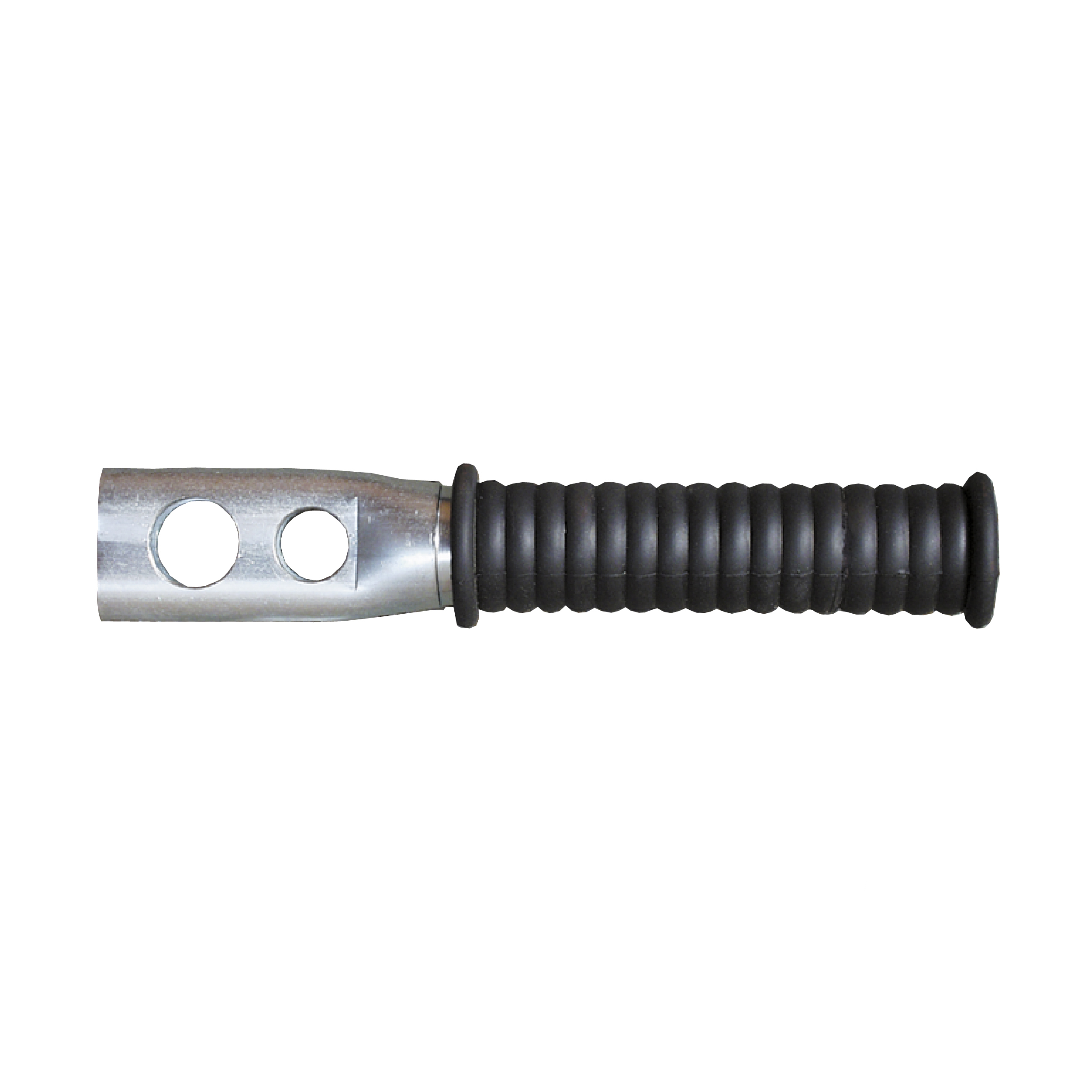 |
FS41 – Withdrawal Handle | Ergonomic pull handle for easy withdrawal and reuse of FS3x/FSHD3x extension rods. | – | Ø 18.5 mm and Ø 22.5 mm | 1 | 0,403 kg | 230 mm | 60 mm | – | FS3x or FSHD3x Rods |
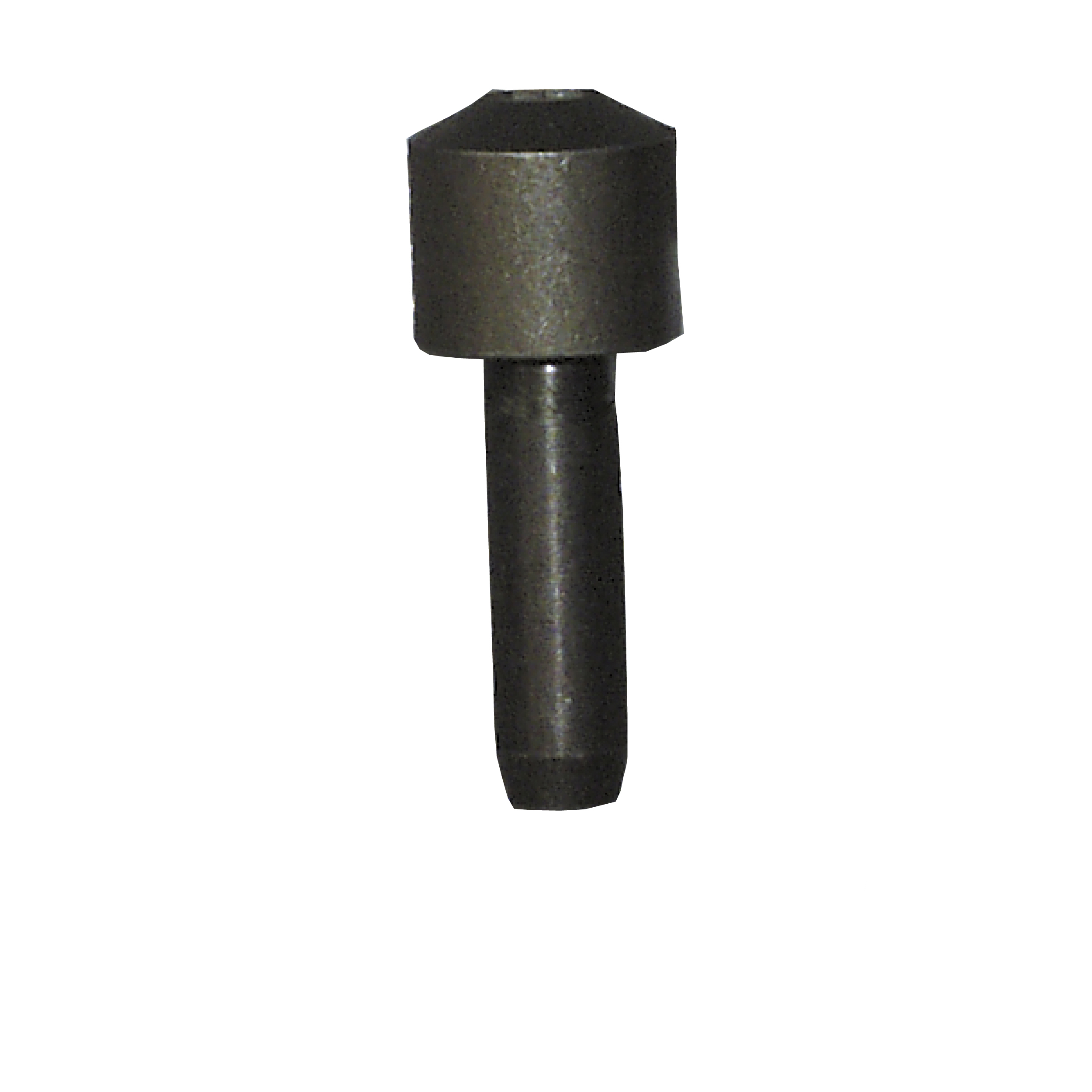 |
FS61 – Impact Stud | Impact stud for sledgehammer driving, preventing rod-end deformation. | – | – | 1 | 0.081 kg | 58 mm | 22 mm | – | – |

Driving Sleeves for FS and FSHD Deep Earthing Systems
| Name | Shaft ∅ | Flange Length | Total Length | Shape | Weight | Note |
| FS71C | 19 mm | 108 mm | 305 mm | Round | 1,8 kg | – |
| FS72C | 22 mm | 108 mm | 305 mm | Round | 1,9 kg | – |
| FS74C | 22 mm | 82 mm | 280 mm | Round | 1,8 kg | – |
| FS77C | 32 mm | 160 mm | 380 mm | Round | 2,5 kg | – |
| FS81C | 18 mm | – | 265 mm | Round | 1,4 kg | 1 |
| FS81D | 18 mm | – | 215 mm | Round | 1,4 kg | 1, TE-Y, SDS MAX |
| FS82C | 19 mm | – | 272 mm | Round | 1,5 kg | 1 |
| FS83C | 29 mm | – | 310 mm | Round | 2,2 kg | 1 |
| FS85C | 27 mm | 80 mm | 302 mm | Square | 2,1 kg | – |
| FS88C | 22 mm | – | 288 mm | Round | 1,7 kg | 1, TE-S |
| FSHD71C | 19 mm | 108 mm | 305 mm | Round | 1,8 kg | – |
| FSHD72C | 22 mm | 108 mm | 305 mm | Round | 1,9 kg | – |
| FSHD74C | 22 mm | 82 mm | 280 mm | Round | 1,8 kg | – |
| FSHD77C | 32 mm | 160 mm | 380 mm | Round | 2,5 kg | – |
| FSHD81C | 18 mm | – | 265 mm | Round | 1,4 kg | 1 |
| FSHD83C | 29 mm | – | 310 mm | Round | 2,2 kg | 1 |
Frequently Asked Questions

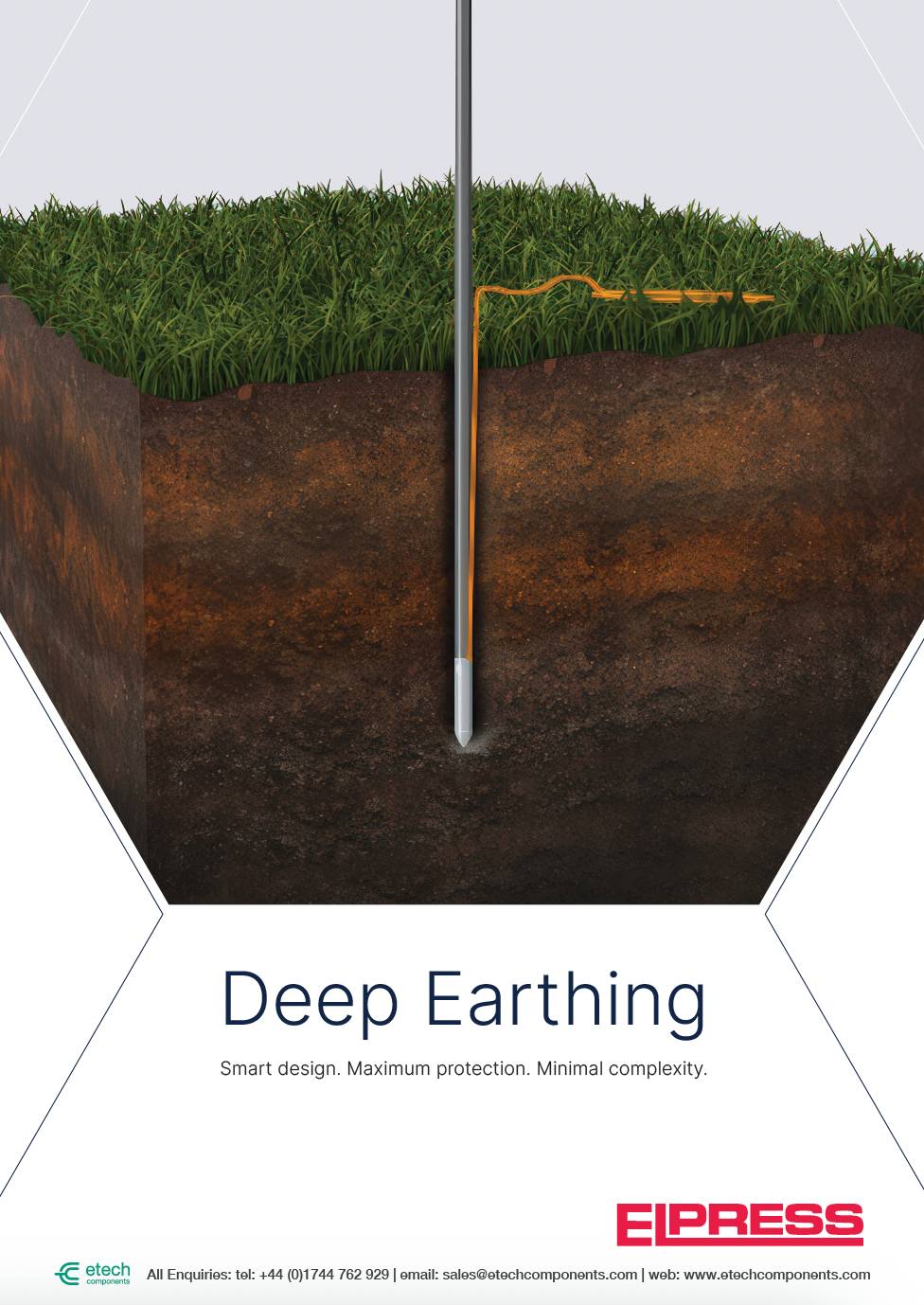
What is the Elpress Deep Earthing System?
It is a modular deep grounding solution that installs a continuous copper conductor into deeper soil layers for stable electrical earthing performance.
Why is deep earthing better than surface earthing?
Deep earthing reaches more stable soil conditions with less variation from weather, resulting in more consistent earth resistance.
How does soil resistivity affect earthing systems?
Soil resistivity determines how easily electrical current can be discharged into the ground. High resistivity soils require deeper or more engineered grounding solutions.
What is continuous resistance monitoring?
It is the ability to measure earth resistance during installation, allowing installers to stop at the optimal grounding depth.
Where is the Elpress system used?
It is used in wind farms, substations, rail infrastructure, telecommunications sites and lightning protection systems.
Does the system reduce corrosion risk?
Yes. Steel components act as sacrificial anodes, helping protect the copper conductor and extend system life.
Conclusion
The Elpress Deep Earthing System addresses these challenges through a controlled and engineered installation method that combines a continuous copper conductor, modular driven rods and real-time earth resistance monitoring. By enabling installers to verify and optimise grounding performance during installation, it delivers a more predictable, stable and verifiable earthing solution for demanding infrastructure applications. In an industry where safety, compliance and operational reliability are non-negotiable, deep earthing is no longer optional. It is essential, and Elpress provides a proven way to achieve it.

| 📞 +44 (0)1744 762 929 | 📧 sales@etechcomponents.com | Elpress: Learn More |