


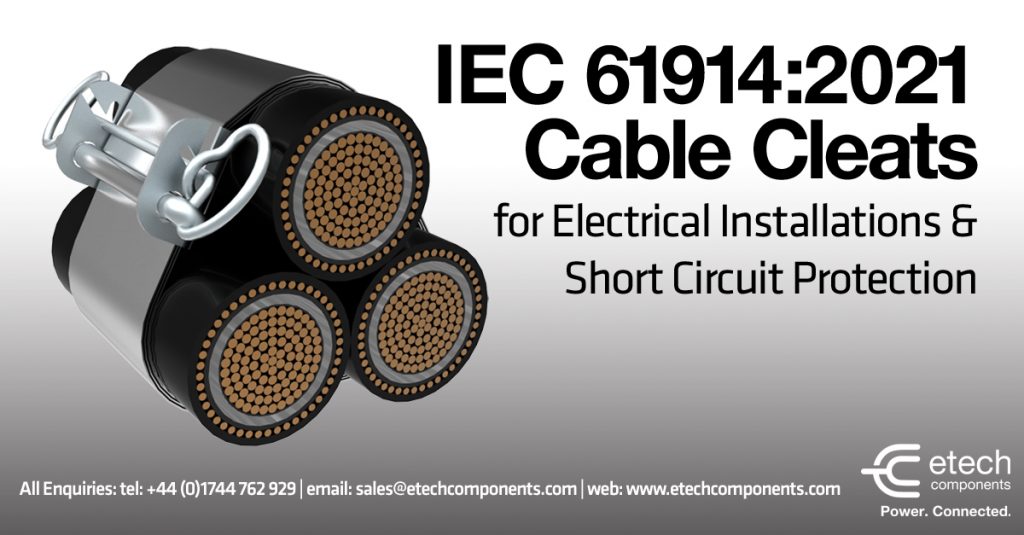
Cable Cleats play a vital role in electrical installations by securing cables at intervals along their length, as defined by IEC 61914. They help retain and support cables, limit unwanted movement, and provide resistance to electro-mechanical forces, ensuring the safety and reliability of electrical systems. Properly selected and installed cleats can prevent damage to cables, reduce maintenance costs, and improve the overall longevity of an installation. In this blog, we’ll take a closer look at the IEC organisation, explain what IEC 61914:2015 covers, and highlight the range of Cable Cleats we offer here at E-Tech Components.
| View Our Range of Cable Cleats Here |
What is IEC?

The International Electrotechnical Commission (IEC) is the world’s leading organisation that prepares and publishes International Standards for all electrical, electronic and related technologies. Each and every day, millions of electronic devices use or generate electricity. So they rely on IEC’s International Standards and Conformity Assessment Systems to ensure safe, reliable performance and compatibility.
What is IEC 61914?
IEC 61914 sets out the requirements and tests for cable cleats and intermediate restraints used to secure cables in electrical installations. It also evaluates the performance and durability of a Cable Cleat’s design. Additionally, the standard provides formulas to calculate the theoretical forces between conductors in the event of a short circuit.
Although the standard does not define pass or fail levels, it allows manufacturers to specify the performance characteristics of their products. It also enables specifiers to compare products from different manufacturers. The aspects of construction and performance covered by IEC 61914 include:
- Material type – metallic, non-metallic or composite
- Minimum and maximum declared service temperatures
- Resistance to impact at the minimum declared operating temperature
- Ability to withstand axial slippage forces
- Resistance to electro-mechanical forces – the ability of the cleat to withstand forces between cables during a short-circuit fault
- Resistance to UV rays and corrosion
- Flame propagation
Note: IEC 61914 does NOT apply to cable glands and cable ties!
Industries and Sectors that Use IEC 61914 Cable Cleats
IEC 61914 Cable Cleats are used across a wide range of heavy industries, providing reliable support and protection for electrical cables during the extreme electromechanical forces generated in a short circuit.
- Energy and Utilities – Standard in power plants and substations, where high fault levels demand robust cable retention
- Oil & Gas and Mining – Essential for maintaining cable integrity in harsh, corrosive and high-vibration environments
- Renewable Energy – Used in wind turbines and other renewable installations to manage thermal expansion and provide secure vertical support
- Transportation and Data Centres – Cleats ensure public safety in confined spaces, such as rail tunnels, and prevent costly downtime in critical digital infrastructure
By specifying IEC 61914-compliant cleats, these industries can be confident that their cable supports have passed rigorous mechanical, thermal and fire safety testing, providing long-term reliability and reduced maintenance risk.
Materials Used in IEC 61914 Cable Cleats
IEC 61914 Cable Cleats are manufactured from a wide variety of materials, carefully selected to meet the mechanical and environmental demands of different installations.
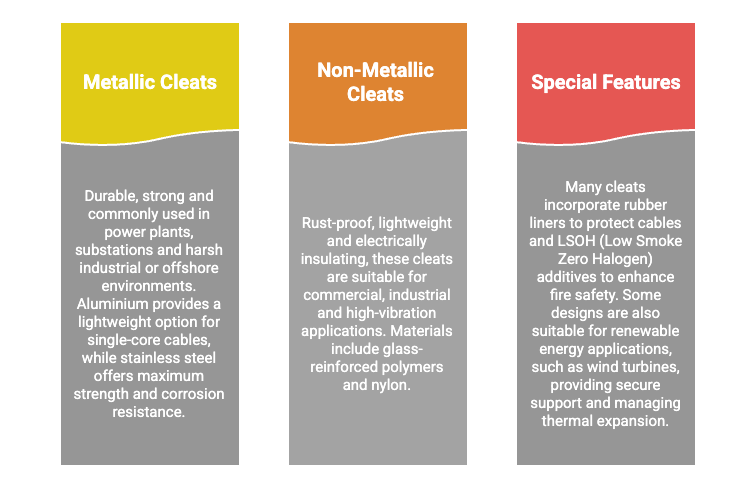

Choosing the right material ensures the cleat can withstand mechanical forces, temperature extremes, UV exposure and chemical corrosion, while providing optimal protection for both the cable and the surrounding installation.
What’s New in IEC 61914:2021?
The latest edition, IEC 61914:2021, supersedes the IEC 61914:2015 version and introduces several technical refinements while keeping the standard’s core purpose unchanged. Key updates include:
- Clearer definitions for low-, medium- and high-voltage cables
- Specific test requirements for cleats with liners or inserts
- Additional corrosion resistance classes for plated products
- Durability requirements for product markings to ensure long-term traceability
- Refined mechanical testing, including clarified mandrel specifications
- Axial load testing for multi-cable cleats
- Lateral load testing for intermediate restraints
These improvements make testing more precise and help specifiers and manufacturers ensure cleats remain reliable in modern electrical installations.
| Correct Cable Cleat Spacing Guide |
IEC 61914 Cable Cleats from E-Tech Components
At E-Tech Components, we are committed to quality in everything we do. This means we don’t just meet industry testing standards for Cable Cleats. We exceed them! As part of this commitment, all our Cable Cleats and Clamps are designed and tested to the requirements of IEC 61914:2015.
We offer a wide range of Cleats and Clamps, from Single Way Cable Cleats and Trefoil Cleats to Quad Cleats and Bespoke Solutions. They are all designed and manufactured to meet your specific application requirements. We work closely with the world’s largest cable manufacturer, The Prysmian Group, distributing Prysmian Cable Cleats to major projects around the globe. Prysmian’s BICON range has been tried and tested over many years, and all products are third-party tested and certified to the latest international standards. We also partner with Slagboom Electric, offering their Dutchclamp range of Non-Metallic Single Way and Trefoil Cleats.
With such a comprehensive portfolio, our Technical Sales Team is ready to help you choose the perfect Cable Cleat for your project.
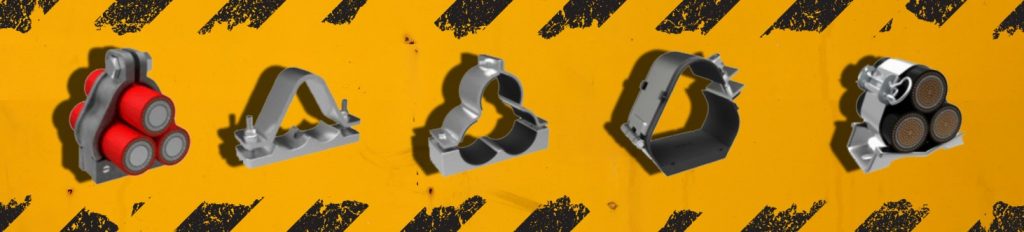

Our Range of Cable Cleats
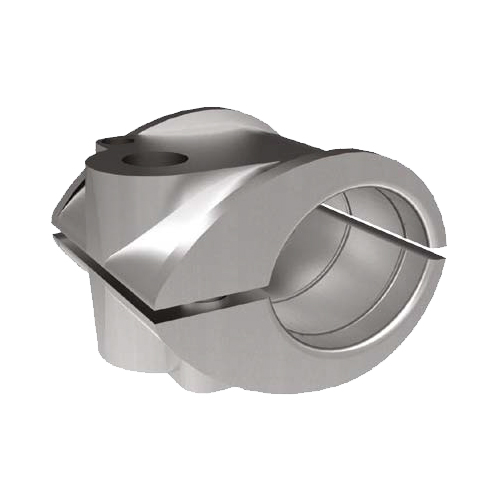 |
Single Way Cable CleatsWe offer a wide range of cleats designed to meet your specific application requirements. You should always consider factors such as the environment, support structure, required mechanical strength, cable size and any special characteristics. |
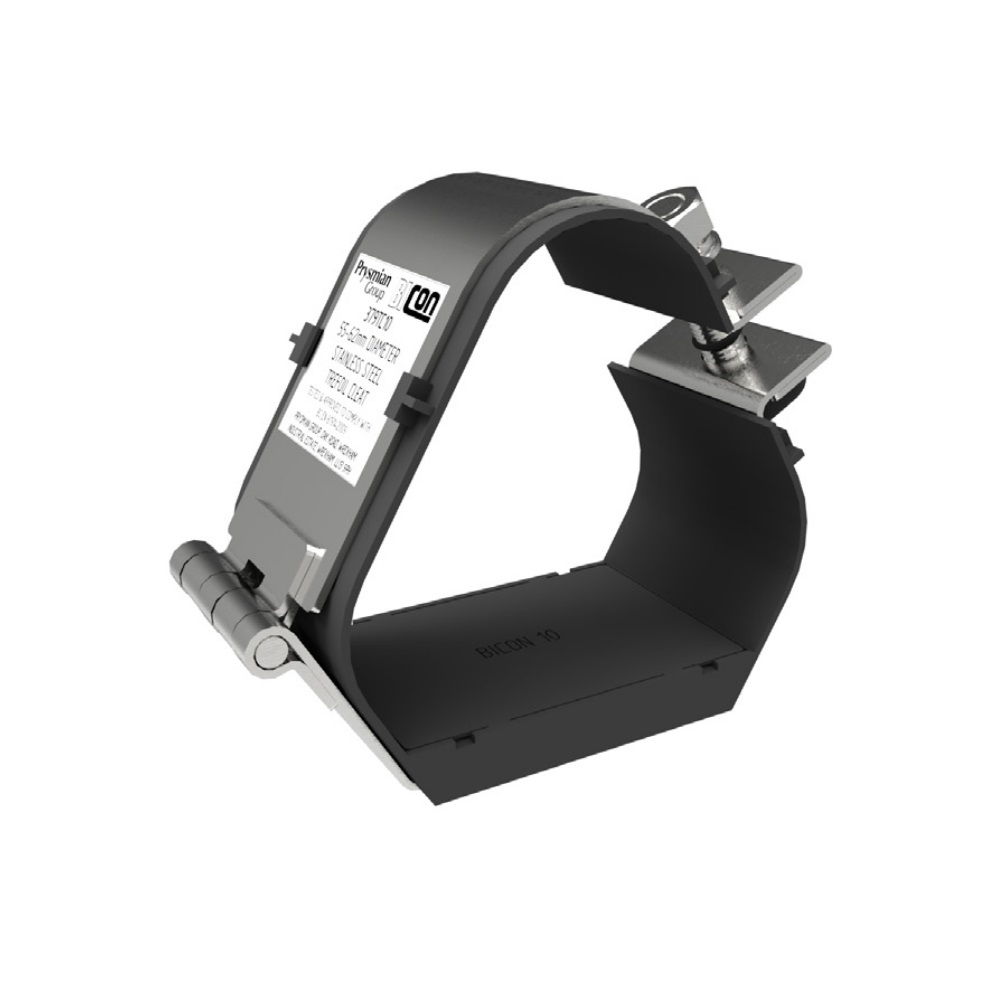 |
Trefoil Cable CleatsDesigned to securely hold three cables in a trefoil formation, we offer materials such as stainless steel, aluminium, non-metallic options and SS316L. When selecting the right cleat for your application, it is important to consider several factors. This includes the environment, support structure, fault level (kA peak), cable size / range, and the use of liners. We provide products from leading suppliers, including Prysmian BICON, Dutchclamp and CCG. |
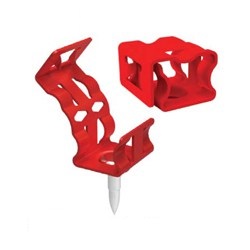 |
Fire Resistant Cable CleatsFast and easy to install, these cleats provide fire resistance while meeting the cable support requirements of British Standards. These cleats are suitable for all types of cable routes and can be used in a wide range of environments. |
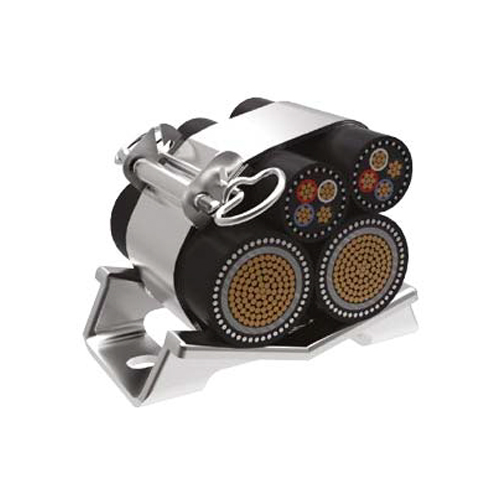 |
Bespoke Cable Cleat Solutions
We also offer a full range of custom, bespoke and off-the-shelf products designed to meet your specific application requirements. |
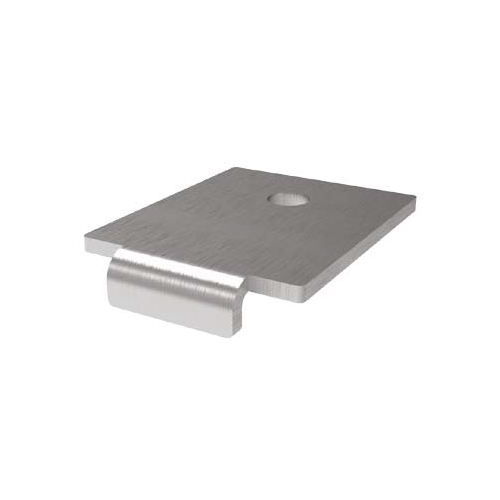 |
Cable Cleat AccessoriesOur range includes fixing kits, rods, hex nuts, washers and other components for stacking claw cleats or mounting smaller cleats directly onto a 41 mm wide channel, etc. These accessories are supplied by leading manufacturers, including Prysmian BICON and Dutchclamp. |
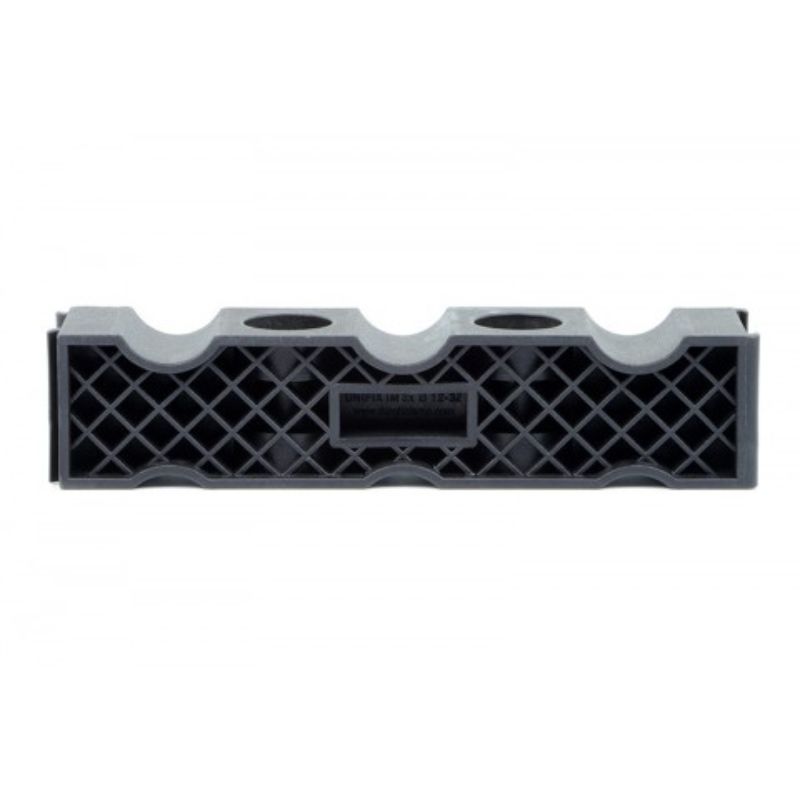 |
Cable Blocks (Transits)We offer Dutchclamp Cable Blocks (Transits) for the short-circuit-proof mounting of cables with diameters between 12 mm and 48 mm. They are also suitable for securing three single or multicore low, medium and high voltage cables with overall diameters from 27 mm to 38 mm. These blocks are also suitable for mounting tubes and hoses. |


Frequently Asked Questions
What is the purpose of a cable cleat in an electrical installation?
Cable cleats secure and support cables at intervals to prevent movement, reduce damage risk and withstand short-circuit electro-mechanical forces.
What does IEC 61914 cover?
IEC 61914 defines the requirements and test methods for cable cleats and intermediate restraints used to secure cables in electrical installations.
Does IEC 61914 define pass or fail performance levels?
No. The standard requires manufacturers to declare tested performance so specifiers can compare products rather than setting universal pass/fail thresholds.
What materials are commonly used for IEC 61914 Cable Cleats?
Cable cleats are typically made from metallic materials like aluminium and stainless steel or non-metallic materials such as glass-reinforced polymers and nylon.
What changed in IEC 61914:2021 compared to the 2015 edition?
The 2021 update refines testing and classification with clearer voltage definitions, expanded corrosion classes, lined-cleat testing, improved marking durability, and more precise mechanical load tests.
Are cable glands and cable ties covered by IEC 61914?
No. IEC 61914 applies only to cable cleats and intermediate restraints, not cable glands or cable ties.
Who publishes IEC 61914?
IEC 61914 is published by the International Electrotechnical Commission, the international authority for electrical and electronic standards.
FREE Technical Advisory Service
E-Tech Components UK Ltd maintains a free technical advisory service.
Contact us about any questions, enquiries or requests you may have.
| 📞 +44 (0)1744 762 929 | 📧 sales@etechcomponents.com | The Definitive Guide to Cable Cleats |